Shakers / Guide
What size shaker bottle do I need? The scoop, the liquid and the air above both
Capacity is not the same as what fits. A shaker needs room for the powder, the liquid and a third of the bottle empty so the ball can move. Here is the arithmetic, and the size each use case lands on.
By Mike M.Updated Researched from maker spec pages
#adMeal & Macro earns from qualifying Amazon purchases. Prices are set by the retailer and change. A commission never decides a ranking. How we score · Disclosure
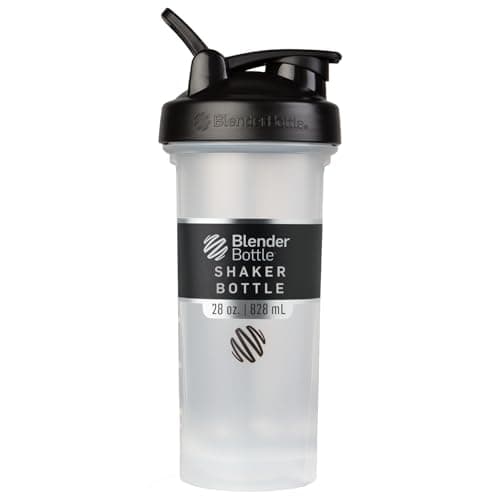
The arithmetic
People buy shakers on the printed capacity and then find the shake leaks or will not mix. The reason is that three things have to fit, not one:
- The powder. A typical 30 g whey scoop occupies roughly 1.5 to 2 fluid ounces of volume dry, and it does not disappear when it dissolves — a 30 g serving adds about an ounce to the final liquid volume. Two scoops is therefore about 2 oz of added volume, more for a bulkier mass gainer or a greens powder.
- The liquid. Most label directions are 8 to 12 oz of water or milk per scoop. For two scoops that is 16 to 24 oz, and most people pour 12 to 16.
- The air. This is the part nobody budgets for. A wire whisk ball or an agitator needs space to travel; a bottle filled to the neck does not mix, it sloshes. Allow a third of the bottle empty as a working rule.
Put those together for a standard two-scoop shake: 2 oz of powder volume plus 14 oz of liquid is 16 oz of contents, which needs a bottle of roughly 24 oz at the absolute minimum and 28 oz comfortably. That is why 28 oz is the size the whole category settled on, and why 20 oz bottles feel small the first time you use one with two scoops.
For a meal-replacement dose rather than a whey scoop, the same arithmetic pushes you to 27 or 28 ounces and rules out strainers entirely: best shaker bottle for Huel.
By what you mix
| What you mix | Contents | Bottle size | Note |
|---|---|---|---|
| One scoop of whey | 1 oz powder volume + 8–10 oz liquid | 20 oz | A 20 oz bottle is exactly right here and cramped for anything more |
| Two scoops of whey | 2 oz + 12–16 oz liquid | 26–28 oz | The default case; 28 oz leaves real shaking room |
| Casein or a thick blend | 2 oz + 14–16 oz, and it thickens as it sits | 28 oz | Thick powders need more agitation, so more air |
| Mass gainer | 4–6 oz powder volume + 16–24 oz liquid | 32–45 oz | BlenderBottle sells the Classic in 45 oz for exactly this |
| Creatine or pre-workout | 5 g powder + 8–12 oz liquid | 20 oz | Tiny dose; the bottle is a water bottle with a job |
| Intra-workout sipping | Electrolytes or EAAs + 20–30 oz | 32 oz+ | Capacity for the session, not for mixing |
Powder volumes are approximate and vary by product density — a greens powder or a gainer takes far more volume per gram than whey. Liquid figures follow typical label directions.
If the dose is creatine specifically, the bottle matters less than what the lid does about grit on the base — that is covered on best shaker bottle for creatine. Pre-workout has its own quirk, which is that you want it mixed thin and drunk fast: best shaker bottle for pre-workout.
Why headroom is non-negotiable
Three separate failures all trace back to filling a bottle too full, and all three get blamed on the bottle:
- It will not mix. A whisk ball needs to fall through liquid to break up powder. Fill a bottle to the neck and the ball barely moves — you get a layer of dry powder welded to the base and lumps on the surface. The technique fixes are on how to mix protein powder without clumps.
- It leaks. A full bottle shaken hard puts real pressure on a flip cap. Most leak complaints about perfectly good bottles are a full-fill problem, not a seal problem — which is also why makers like VOLTRX publish a working fill well below the stated capacity.
- It foams. Over-shaking a full bottle whips air into the protein and you drink a head of foam. Less liquid, fewer shakes, and let it stand thirty seconds.
What makers actually sell
The category is narrower than it looks. BlenderBottle publishes the Classic V2 in 20, 28 and 45 oz, and the Strada Tritan in 24 and 28 — so 28 is the size both of its main lines centre on. Insulated steel bottles cluster lower: 20, 24 and 26 oz, because vacuum walls add diameter and weight and a 32 oz steel shaker full of liquid is genuinely heavy. Electric shakers cluster at 20 to 24 oz because the motor base takes up the bottom of the bottle.
That gives a simple rule when you are comparing across materials: a steel bottle's printed capacity buys you less shake than a plastic one's, because the wall is thicker and the working fill is lower. A 24 oz insulated steel shaker is a one-and-a-half-scoop bottle in practice; a 28 oz plastic one is a comfortable two.
The steel exception
If you are buying insulated steel, size is a trade against two other things you probably wanted. Steel gives you a published cold-hold figure — the Ice Shaker's "ice-cold for 30+ hours", BlenderBottle Sport Steel's "cold for up to 24 hours" — and it costs you capacity and weight. The honest framing:
- 20 oz steel (Stanley Vitalize): one scoop, 8 hours cold, 30 iced, and a 3 oz powder compartment on the base so the second serving travels dry.
- 24 oz steel (BlenderBottle Sport Steel): one and a half scoops with headroom, a locking cap and a 24-hour cold claim.
- 26 oz steel (Ice Shaker): two scoops if you respect the 20 oz line, 30+ hours cold, and the heaviest bottle of the three.
A storage bottle narrows the same arithmetic again, because the compartment steals height and the markings usually stop short of the stated capacity — the jar volumes against a real scoop are worked through on best shaker bottle with storage.
If cold-hold does not actually matter to you — if the shake is mixed and drunk within twenty minutes — plastic at 28 oz is the better buy on every axis. The whole steel tier, ranked on published figures, is on best stainless steel shaker bottle, and the overall field is on best shaker bottle.
The bottles this leads to
Our picks for this
One bottle per size band
28 oz plastic as the default, then the three steel sizes with what each one really holds.
Best all-round shaker
BlenderBottle Classic V2 (28 oz)
BPA-free plastic · wire whiskDishwasherLeak-resistant8.1/1028 oz, a stainless wire-whisk ball, a leakproof claim, every part dishwasher safe and a limited lifetime guarantee. The two-scoop default, and the size BlenderBottle centres its line on.
$9.99Amazon#ad · Price as of November 4, 2026 · Disclosure for the link to BlenderBottle Classic V2 (28 oz)
Best insulated whisk shaker
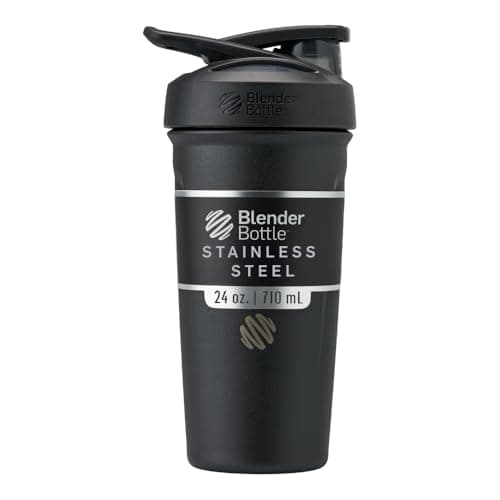
BlenderBottle Sport Flip Stainless Steel (24 oz)
Insulated steel · locking capInsulated8.1/1024 oz of double-wall insulated steel rated cold for up to 24 hours, with a lockable push-button cap. One and a half scoops with real headroom.
$19.97Amazon#ad · Price as of November 4, 2026 · Disclosure for the link to BlenderBottle Sport Flip Stainless Steel (24 oz)
Best cold-hold shaker
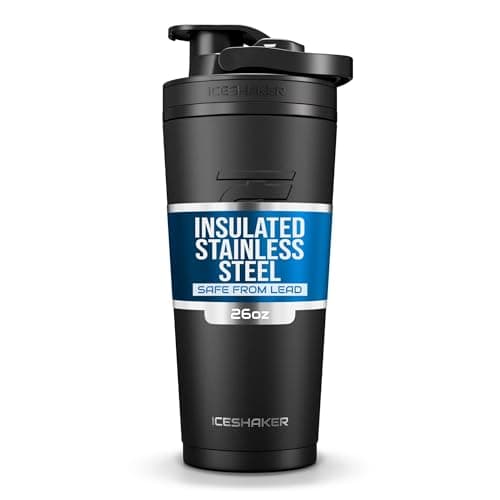
Ice Shaker 26 oz Stainless Steel
Vacuum steel · 30+ h coldInsulatedLeak-resistant8.2/1026 oz with internal lines at 5, 10, 15 and 20 oz — treat 20 as the fill limit — plus a 30+ hour cold claim and a twist-on lid the maker calls 100% leak-proof.
$34.99Amazon#ad · Price as of November 4, 2026 · Disclosure for the link to Ice Shaker 26 oz Stainless Steel
Best shaker with a powder compartment
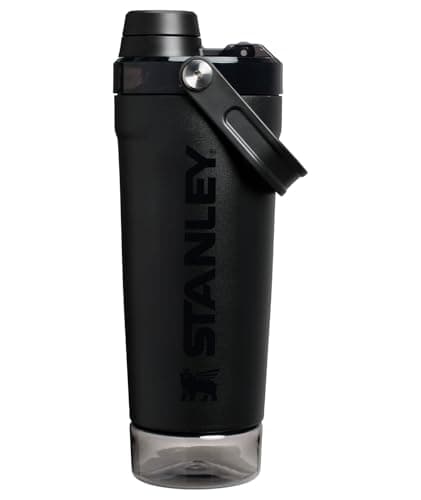
Stanley Vitalize Shaker Bottle (20 oz)
18/8 steel · 3 oz powder base · 8 h coldInsulatedDishwasherLeak-resistant7.4/1020 oz: a one-scoop bottle, 8 hours cold and 30 iced, dishwasher safe, with a 3 oz screw-on base container for the serving you have not mixed yet.
$40.00Amazon#ad · Price as of November 4, 2026 · Disclosure for the link to Stanley Vitalize Shaker Bottle (20 oz)
How Meal & Macro picks gear
Researched, compared and scored
Every pick starts with the maker's own product page and manual: the lid, material and care ratings in its exact wording ("leak-proof", "oven safe to 450°F", "top-rack only"), the container-fit and ice-pack arithmetic worked out from published dimensions and the USDA's numbers, and a score on a public rubric for the category that weights the seal, the material and the fit first. Models are compared side by side, so each page lands on one clear pick per use case with the reason stated. Every figure links to where it came from; where the maker's page would not load we cite a retailer and say so.
Scores are editorial judgments built from that documented research. Commissions never set a score or decide a pick. The rubrics and their weights are published.
Questions
Frequently asked
Is a 20 oz shaker bottle big enough?
For one scoop and 8 to 10 oz of liquid, yes. For two scoops it is not: you need roughly 16 oz of contents plus a third of the bottle empty for the ball to move, which puts you at 26 to 28 oz.
How many ounces should a protein shaker be?
28 oz for a standard two-scoop shake. That covers about 2 oz of powder volume, 12 to 16 oz of liquid and the headroom shaking needs. Go to 32 to 45 oz only for mass gainer or intra-workout drinks.
How full should you fill a shaker bottle?
About two thirds. Use the highest printed measurement line as the limit — the Ice Shaker 26 oz, for example, stops its internal markings at 20 oz. Overfilling is the usual cause of leaks, lumps and foam.
Does a bigger shaker mix better?
Up to a point, yes — more air above the liquid means the whisk ball travels further and breaks up more powder. Past about 28 oz you gain capacity rather than mixing, and a full large bottle is heavy and awkward to shake hard.
Keep reading
Related on Meal & Macro
- Best shaker bottleThe full field, once the size is settled.
- Best stainless steel shaker bottleWhere capacity trades against cold-hold.
- How to mix protein powder without clumpsThe technique side of the headroom rule.
- Best shaker bottle for creatineWhen the dose is 5 g rather than two scoops.
- How to clean a shaker bottleWhat a bigger bottle means for washing up.
Receipts
Sources
- BlenderBottle — Classic V2 page (20/28/45 oz, BlenderBall whisk, leakproof, dishwasher safe, dimensions, limited lifetime guarantee) (checked 2026-09-21)
- BlenderBottle — FAQ (all pieces dishwasher safe; BlenderBall in the silverware bin) (checked 2026-09-21)
- BlenderBottle — Sport Stainless Steel shaker page (24 oz, double-wall insulated, cold up to 24 hours, lockable flip cap) (checked 2026-09-21)
- Ice Shaker — 26 oz Stainless Steel Ice Shaker page (ice-cold 30+ hours, twist-on leak-proof lid, noise-free agitator, carry handle) (checked 2026-09-21)
- Ice Shaker — 26/32/36 oz shaker bottles page (double wall vacuum insulated kitchen-grade stainless, internal 5/10/15/20 oz lines; wording via the search index) (checked 2026-09-21)
- Stanley — Vitalize Shaker Bottle 20 OZ page (20 oz with a 3 oz Tritan base container, 18/8 recycled stainless, cold 8 hours and iced 30 hours, leakproof Tritan lid with a fast-flow spout and removable strainer, dishwasher safe, not for hot liquids, dimensions, 1.35 lb, BPA-free) (checked 2026-09-28)
- VOLTRX — VortexBoost page (24 oz, BPA-free Tritan, 1000 mAh, USB-C 2-hour charge, IPX5 base, cup dishwasher / base not) (checked 2026-09-21)
Materials, capacities, seals and care ratings come from the maker's own product pages and manuals (linked on every product) or, where the maker's page would not load, from a retailer listing we label as such. Food-safety numbers are quoted from the USDA and FDA pages linked above. Where a figure isn't published we say so. Amazon sets the prices and changes them often, so the button on every pick checks today's. Read the full method.