Cook & Freeze / Guide
Is a vacuum sealer worth it for meal prep? Only if you freeze raw food in bulk
The machine is a one-off; the bags are forever. That single fact decides the answer, and it splits meal preppers cleanly into the people who will use one twice a week and the people who will use it twice a year.
By Mike M.Updated Researched from maker spec pages
#adMeal & Macro earns from qualifying Amazon purchases. Prices are set by the retailer and change. A commission never decides a ranking. How we score · Disclosure
The short answer
Ask what you are actually trying to prevent. USDA FSIS is unambiguous that food held at 0°F is safe indefinitely — freezing does not make food unsafe, and thawing does not make it dangerous if it is handled properly. What freezing costs you is quality, and quality is lost almost entirely through one mechanism: moisture leaving the surface of the food and crystallizing elsewhere in the package. That is freezer burn, and it is caused by air contact.
A vacuum sealer removes the air. That is the whole value proposition, and it means the question "is it worth it" reduces to "how long is your food in the freezer, and is it raw?"
What it actually buys you
Four concrete things, in descending order of how much they matter to a meal prepper:
- Buying protein in bulk without wasting it. This is the honest financial case. A family-pack of chicken thighs or a whole case of salmon portioned and sealed on the day you buy it holds its quality for months rather than weeks. If your freezer currently holds four half-used supermarket trays going pale at the edges, a sealer pays for itself in food you stop throwing out.
- Flat, stackable packages. A sealed, flattened portion is maybe a third of the freezer volume of the same food in a rigid container, and it freezes faster because it is thinner. For a freezer that is the constraint on how much you can batch, this is the real win.
- Marinating that actually works. Pulling the air out pulls marinade into the surface of the meat, and the bag holds it in contact rather than letting it pool. This is also where the moist setting earns its place — see below.
- Sous vide. If you cook that way at all, the sealer stops being optional. The site's dedicated page for that case is best vacuum sealer for sous vide.
Three cases where it is not worth it
1. You freeze cooked meals, not raw ingredients. A portion of chili or a tray of cooked rice going into the freezer for three weeks does not need a vacuum. It needs a rigid container with a lid and as little headspace as possible, or a silicone tray that turns the portion into a block you can bag. The ranked field for that is best freezer containers for meal prep, and the technique is on how to freeze meal prep without freezer burn.
2. You seal less than once a month. Every sealer here is a counter appliance: the NESCO is 17 inches wide and 10 pounds, the Anova 14.75 inches, the FoodSaver 16.3 inches and 6 pounds. A machine used occasionally lives in a cupboard, and a machine in a cupboard does not get used. Below roughly a twice-a-month rhythm, press-out-the-air freezer bags are the rational tool — that comparison is on vacuum sealer vs freezer bags.
3. Your freezer is a drawer under a fridge. The sealer's best trick is flat packages that stack, and that pays off most in a chest or upright freezer where you are storing weeks of food. In a shallow freezer drawer holding a week of meals, the volume saved is real but small.
The bags are the real cost
This is the part most buying guides skip. A vacuum sealer is a one-time purchase and a permanent consumable habit: every portion costs you a length of textured bag material, cut, sealed at one end, filled, then vacuumed and sealed at the other. Three published details change how much of that you waste:
- Bag width. FoodSaver's FM2000 is compatible with 11-inch by 10-foot rolls; the NESCO takes bags up to 11.8 inches and ships with two rolls (8.6 and 11.8 inches). A wider throat means you can cut a narrow bag for a single chicken breast instead of wasting an 11-inch width on it.
- A built-in cutter and roll storage. The NESCO and the Anova both publish one; the FM2000 does not, so you cut bags with scissors — slower, and a crooked cut is a failed seal.
- Double seal. Both the NESCO ("3 'Seal' settings — Dry, Moist, and Double") and the Anova offer it. A double weld is the difference between a bag that survives six months under other frozen items and one that quietly loses its vacuum in week eight — and a re-seal costs another inch of bag.
If the recurring bag cost is the thing putting you off, that is a legitimate reason to buy containers instead. It is also the reason reusable silicone bags exist, though they do not pull a vacuum.
Which specs matter if you do buy
| Machine | Power | Modes | Bag handling | Footprint |
|---|---|---|---|---|
| FoodSaver FM2000 | "120W" | No moist/dry or pulse in the wording we could read | "11'' × 10' rolls"; no cutter or roll storage listed | "H: 4.0" W 16.3" × 9.2" D"; 6 lb |
| NESCO VS-12 Deluxe | "130-Watt" "25.1 InHG double vacuum pump" | "Dry, Moist, and Double" seals; vacuum "Normal or Gentle"; pulse | "11.8" width bag"; built-in cutter and roll storage; two rolls included | "17 × 15 × 9 in"; 10 lb |
| Anova Precision Vacuum Sealer Pro | "110 Watts"; extraction "12L/min" | Double seal; moist vs dry; pulse; "over 100 continuous vacuum seals" | Built-in bag storage and cutter; accessory port; one roll included | "14.75 × 7 × 4.3 in" |
Each figure is the maker's own published wording. FoodSaver's site blocked our reader, so its row is that maker's wording as indexed, which is why its spec sheet is thinner.
Two specs decide more than wattage does. A moist setting is the one you will miss if you seal marinated chicken or anything with a sauce, because a standard dry weld through a wet bag mouth fails. And a continuous-seal rating — Anova publishes "over 100 continuous vacuum seals" — matters if your prep style is one big batch day rather than three bags at a time, because a small pump overheats and locks out mid-session.
The three machines
Our picks for this
If the answer is yes, these three
The entry machine, the one with the most control, and the one built for a long batch day.
Best starter vacuum sealer
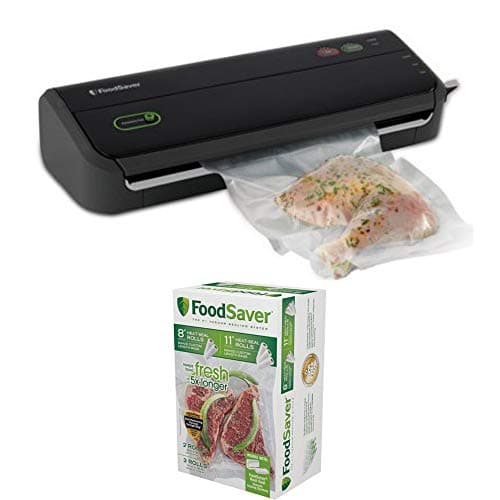
FoodSaver FM2000 Vacuum Sealing System
11 in bags · 120 W · dishwasher drip trayDishwasher7.3/10The honest entry point: 120 W, standard 11-inch rolls, a removable dishwasher-safe drip tray and an accessory hose for canisters, at 6 lb and 16.3 inches. No moist mode and no cutter, which is what you give up.
$149.99Amazon#ad · Price as of November 4, 2026 · Disclosure for the link to FoodSaver FM2000 Vacuum Sealing System
Best vacuum sealer for wet food
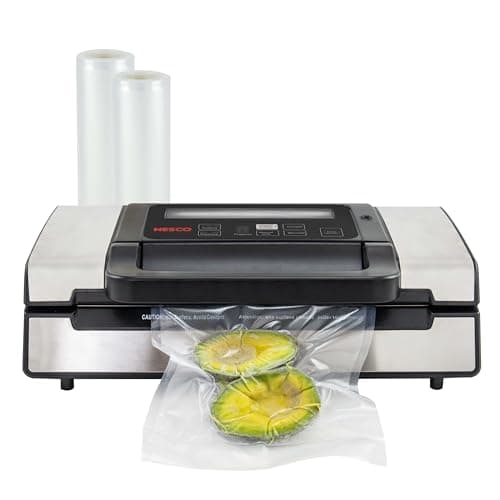
NESCO Deluxe Vacuum Sealer VS-12
130 W double pump · 11.8 in bags · moist mode7.5/10The most control at this level: a 130 W double pump with dry, moist and double seal settings, normal and gentle vacuum, a pulse button, a cutter and roll storage, and 11.8-inch bag width. It is also the biggest — 17 inches and 10 lb.
$133.99Amazon#ad · Price as of November 4, 2026 · Disclosure for the link to NESCO Deluxe Vacuum Sealer VS-12
Best vacuum sealer for volume
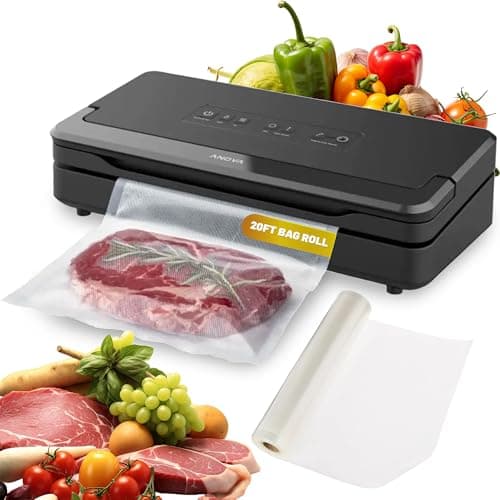
Anova Precision Vacuum Sealer Pro
110 W · double seal · 2-year warranty7.5/10Built for volume: double seal, moist and dry, pulse, an accessory port, and a stated rating of over 100 continuous seals, with the longest warranty here at 2 years in a 14.75-inch body.
$100.99Amazon#ad · Price as of November 4, 2026 · Disclosure for the link to Anova Precision Vacuum Sealer Pro
How Meal & Macro picks gear
Researched, compared and scored
Every pick starts with the maker's own product page and manual: the lid, material and care ratings in its exact wording ("leak-proof", "oven safe to 450°F", "top-rack only"), the container-fit and ice-pack arithmetic worked out from published dimensions and the USDA's numbers, and a score on a public rubric for the category that weights the seal, the material and the fit first. Models are compared side by side, so each page lands on one clear pick per use case with the reason stated. Every figure links to where it came from; where the maker's page would not load we cite a retailer and say so.
Scores are editorial judgments built from that documented research. Commissions never set a score or decide a pick. The rubrics and their weights are published.
Questions
Frequently asked
Does a vacuum sealer actually make food last longer?
In the freezer it preserves quality rather than extending safety — USDA FSIS states that food held at 0°F is safe indefinitely. What a vacuum removes is air contact, which is the cause of freezer burn, so sealed food still tastes right months later instead of weeks later.
Is a vacuum sealer worth it for meal prep?
It is worth it for raw ingredients bought in bulk and for sous vide. It is not worth it for cooked portions eaten within a few weeks, which a glass container or a silicone freezer tray handles with no consumable cost.
Can you vacuum seal cooked meals?
Yes, and it works best on dry-ish foods. Anything with a sauce needs the moist setting that the NESCO and Anova publish, and soups need freezing into a solid block first — otherwise the pump pulls liquid into the seal and the weld fails.
What size vacuum sealer bags should you buy?
Rolls rather than pre-cut bags, in the widest size your machine takes — 11 inches on the FoodSaver FM2000, up to 11.8 inches on the NESCO — then cut each bag to the portion. Rolls plus a built-in cutter is the cheapest way to seal per meal.
Keep reading
Related on Meal & Macro
- Vacuum sealer vs freezer bagsThe format comparison, if the answer here was 'maybe'.
- Best vacuum sealer for meal prepThe ranked field, scored on published specs.
- Best vacuum sealer for sous videThe one use case where a sealer stops being optional.
- How to freeze meal prep without freezer burnGetting the same result without a machine.
- Best freezer containers for meal prepWhat to buy instead if you freeze cooked portions.
Receipts
Sources
- USDA FSIS — Freezing and Food Safety (0°F keeps food safe indefinitely; storage times are for quality) (checked 2026-09-21)
- FoodSaver — FM2000 Vacuum Sealing System page (dimensions, 6 lb, 120 W, 11 in rolls, removable dishwasher-safe drip tray, accessory hose; page blocked our reader, wording via the search index) (checked 2026-09-21)
- NESCO — Deluxe Vacuum Sealer VS-12P page (130 W double pump, 11.8 in bags, dry/moist/double seal, normal/gentle, pulse, roll storage, dimensions, 10 lb) (checked 2026-09-21)
- Anova — Precision Vacuum Sealer Pro page (dimensions, 110 W, 12 L/min, double sealer, cutter, roll storage, accessory port, 100+ continuous seals, 2-year warranty) (checked 2026-09-21)
- Stasher — Half Gallon Storage Bag page (volume, dimensions, platinum silicone, oven to 425°F, Pinch-Loc seal) (checked 2026-09-21)
- Souper Cubes — 1-Cup Freezer Tray page (portions, dimensions, silicone with steel frame, oven to 415°F trays only, dishwasher, lifetime warranty) (checked 2026-09-21)
Materials, capacities, seals and care ratings come from the maker's own product pages and manuals (linked on every product) or, where the maker's page would not load, from a retailer listing we label as such. Food-safety numbers are quoted from the USDA and FDA pages linked above. Where a figure isn't published we say so. Amazon sets the prices and changes them often, so the button on every pick checks today's. Read the full method.