Containers / Guide
When to replace plastic food containers: six signs, and what each one actually means
Plastic containers do not expire on a date — they fail in six specific, visible ways. Clouding is cosmetic. A warped rim, a stretched gasket or a scratched base are not, and each has a reason worth knowing.
By Mike M.Updated Researched from maker spec pages
#adMeal & Macro earns from qualifying Amazon purchases. Prices are set by the retailer and change. A commission never decides a ranking. How we score · Disclosure
The six signs
There is no expiry date on a food container, and the honest answer to "can you keep reusing meal prep containers" is yes — indefinitely, until the container stops doing its job. These are the six ways it stops:
| Sign | What caused it | Replace? |
|---|---|---|
| Warped rim or domed lid | Heated dishwasher dry cycle, or the bottom rack near the element | Yes — a warped rim cannot seal, and a seal is the whole product |
| Cracks, or fine crazing lines | Age plus flexing, often starting at a latch point or a corner | Yes — cracks trap food and bacteria, and they propagate |
| Gasket that stays flat | Silicone compressed by years of latching, or stretched after removal | Replace the gasket if sold; otherwise the lid |
| Deep knife scratches in the base | Cutting in the container, or metal cutlery | Yes — scratches are where odour and stain lodge permanently |
| Smell that survives a wash | Oils absorbed into polypropylene microstructure | Yes, if baking soda and sun don't clear it |
| Latches that don't click | Fatigue in the plastic hinge — the single most common failure | Yes, and this is usually what ends a set |
Notice that five of the six are about the seal. A container that will not seal has become a bowl with a hat, and that is the practical definition of worn out — whether it looks tired or not.
Retiring the worn ones is half the job; the other half is where the survivors live, which is how to organize and store meal prep containers.
What is cosmetic and what is not
Two very common worries are mostly cosmetic, and binning containers over them wastes money:
- Clouding. Clear polypropylene goes milky from a combination of heat cycles, dishwasher detergent and micro-scratching. It is not a sign of material breakdown and it does not affect the seal. It does make it harder to see what is inside, which is a real nuisance and no more.
- Orange and yellow staining. Tomato, turmeric and curry pigments are fat-soluble and they migrate into the plastic surface. Ugly, harmless, and almost impossible to reverse once set. Some materials resist it far better than others — Rubbermaid markets StainShield plastic as "stain and odor resistant", and Eastman Tritan is described as stain- and odour-resistant too, which is why those appear in shaker bottles.
The one place staining becomes more than cosmetic is when it arrives with a smell. Pigment on the surface is fine; oil absorbed into scratches is what carries odour, and that is a replace. The glass version of this argument — glass simply does not stain or absorb — is on glass vs plastic meal prep containers.
The lid fails before the box
Every long-term container set converges on the same state: plenty of good bases, not enough working lids. The base is thick, holds its shape, and has no moving parts. The lid is thin, gets latched and unlatched twice a day, carries a silicone gasket and takes the worst of the dishwasher's heat because it sits on the top rack nearest the element.
That makes the lid-replacement policy one of the most undervalued specs in this whole category, and makers vary enormously:
- Snapware Total Solutions: "LIMITED LIFETIME WARRANTY" on the plastic lids, two years on the glass. The strongest position we have found on the part that actually fails.
- Pyrex Simply Store: "2-year limited warranty on glass containers and plastic lids" — the lid is explicitly covered.
- Glasslock: gaskets "are not available as a separate replacement part at this time" on the US site, so a torn seal means a new lid.
- Most plastic sets: no published replacement-lid programme at all, which means a cracked latch retires an otherwise fine container.
If you are buying now with longevity in mind, that list is the shortlist. The sets ranked with the lid system front and centre are on best leak-proof meal prep containers and best glass food storage containers.
How to make the next set last
Five habits, ordered by how much difference they make. The first one alone roughly doubles the life of a lid.
- Top rack, no heated dry. Heat is what warps lids, and the heated dry cycle is the single biggest cause of a rim that will not seal. Almost every maker here says top rack only: Sistema says "top rack only", Bentgo says "top-shelf" and recommends hand-washing its Prep lids, Pyrex says lids top rack.
- Never cut in the container. Knife scratches in the base are where odour permanently lodges. Chop on a board; the container is for storage.
- Take the gasket out monthly. Where a gasket is removable, lift it, wash under it, and let both parts dry fully. Trapped moisture under a seal is where smell starts.
- Cool food before sealing. Sealing hot food traps steam, which condenses, and repeated hot cycles are hard on both plastic and gaskets. It also matters for food safety — USDA guidance is shallow containers refrigerated within two hours.
- Dry them open, stored open. Lids stacked separately, boxes nested with the lids off. A sealed empty container stored wet is the most reliable way to produce a smell.
The safety question, answered plainly
The worry behind most of these searches is whether reusing plastic containers leaches something harmful. Two separate facts, both worth stating without drama.
First, the regulatory position: the FDA reviews substances that come into contact with food, and on BPA specifically its published position is that the available information supports the safety of the currently approved uses in food containers and packaging. Separately, essentially every set sold for meal prep today states BPA-free on the packaging — Bentgo goes further and lists no PFAS, BPA, vinyl, lead or PVC; Sistema states "highest quality food grade BPA free materials".
Second, the practical position: the thing that genuinely changes with age is surface integrity. A scratched, crazed container is harder to clean properly, and that is a hygiene argument rather than a chemical one. So the sensible rule is the one at the top of this page — replace on damage, not on a calendar. The longer treatment, with the FDA wording in full, is on are plastic meal prep containers safe, and the non-toxic-first ranking is on best non-toxic food storage containers.
One genuine exception: thin disposable trays. Those are built for a short life, warp after a few hot dishwasher cycles, and are the one category where a replace-on-schedule habit makes sense — the reusable-versus-disposable arithmetic is on reusable vs disposable meal prep containers.
What to replace them with
Our picks for this
Four replacements, by what failed
Match the replacement to the failure: stains and smell point to a better plastic, a dead gasket points to glass, worn-out cheap trays point to a set with a seal.
Best plastic set
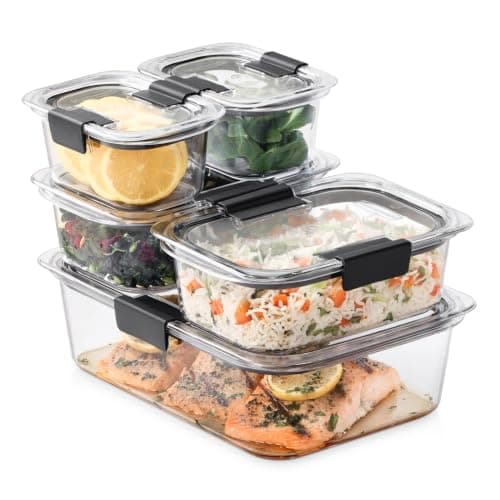
Rubbermaid Brilliance 10-piece Food Storage Set
StainShield plastic · latching lidMicrowaveFreezerDishwasher7.4/10If the old set stained and smelled: StainShield plastic the maker calls stain and odour resistant, latching vented lids with a stated 100% leak-proof seal, and one lid family across the whole Brilliance line.
$22.99Amazon#ad · Price as of November 4, 2026 · Disclosure for the link to Rubbermaid Brilliance 10-piece Food Storage Set
Best clip-lid lunch box
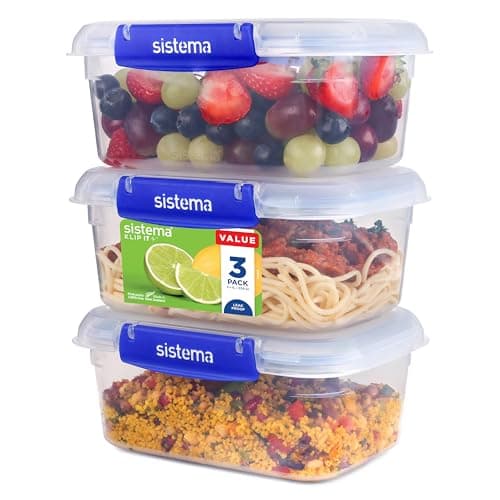
Sistema KLIP IT Plus 1 L Rectangle (3 pack)
PP plastic · locking clipsMicrowaveFreezerDishwasher7.0/10If the latches went: four clips and a flexible built-in seal, with published care rules — top-rack dishwasher, microwave without the lid — so you know how to not break these ones.
$28.76Amazon#ad · Price as of November 4, 2026 · Disclosure for the link to Sistema KLIP IT Plus 1 L Rectangle (3 pack)
Best latching glass set
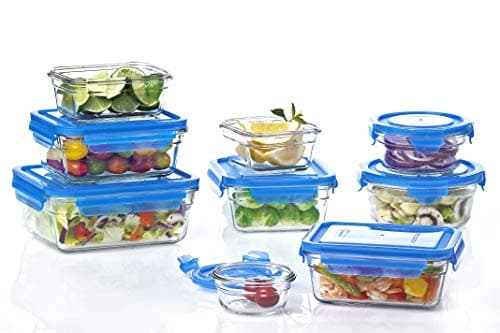
Glasslock 18-piece Oven Safe Set (11292)
Tempered glass · latching lidMicrowaveOvenDishwasher7.7/10If you are done with plastic: tempered glass under four-tab gasketed lids, oven-rated on the oven series. Note the honest caveat — the US site says gaskets are not sold separately.
$38.99Amazon#ad · Price as of November 4, 2026 · Disclosure for the link to Glasslock 18-piece Oven Safe Set (11292)
Best divided set
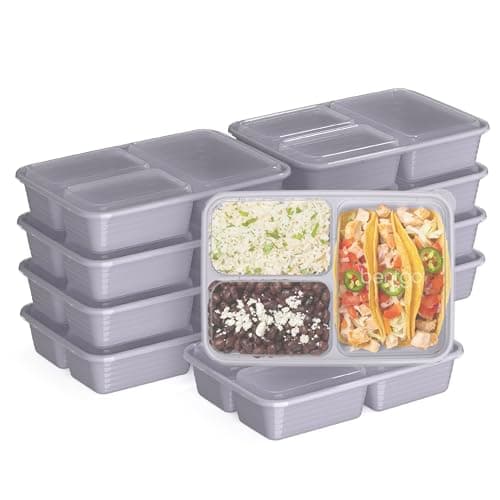
Bentgo Prep 3-Compartment Containers (20-piece)
PFAS/BPA-free plastic · 3 compartmentsMicrowaveFreezerDishwasher6.1/10If worn-out thin trays were the problem: ten 4-cup divided trays at 3 oz each, rated to reheat from fridge or freezer, with hand-wash guidance for the lids so they survive.
$12.53Amazon#ad · Price as of November 4, 2026 · Disclosure for the link to Bentgo Prep 3-Compartment Containers (20-piece)
How Meal & Macro picks gear
Researched, compared and scored
Every pick starts with the maker's own product page and manual: the lid, material and care ratings in its exact wording ("leak-proof", "oven safe to 450°F", "top-rack only"), the container-fit and ice-pack arithmetic worked out from published dimensions and the USDA's numbers, and a score on a public rubric for the category that weights the seal, the material and the fit first. Models are compared side by side, so each page lands on one clear pick per use case with the reason stated. Every figure links to where it came from; where the maker's page would not load we cite a retailer and say so.
Scores are editorial judgments built from that documented research. Commissions never set a score or decide a pick. The rubrics and their weights are published.
Questions
Frequently asked
Can you reuse meal prep containers?
Yes, indefinitely, until the container stops sealing or stops cleaning up. Replace on damage — a warped rim, a crack, a flattened gasket, deep scratches, a smell that survives washing, or latches that no longer click.
How often should you replace plastic food containers?
There is no fixed interval. In daily meal prep use the lids usually give out first, somewhere between one and three years depending on how they are washed; the bases often last much longer. Keeping lids off the heated dry cycle is the single biggest factor.
Is cloudy plastic a reason to throw a container out?
No. Clouding comes from heat cycles, detergent and micro-scratching, and it does not affect the seal. The same goes for tomato and turmeric staining on its own. Replace when the seal or the surface fails, not when it looks tired.
Why do my containers smell even after washing?
Oils absorbed into scratches, usually plus moisture trapped under a gasket. Try a baking-soda paste overnight, a wash, then several hours in sunlight. If two rounds of that fail, the odour is in the plastic and the container is done.
Keep reading
Related on Meal & Macro
- Are plastic meal prep containers safeThe material question, with the FDA's own wording.
- Glass vs plastic meal prep containersWhy glass has no equivalent failure mode.
- Reusable vs disposable meal prep containersWhere replace-on-schedule does make sense.
- Best leak-proof meal prep containersBuying for the part that fails: the lid.
- Best non-toxic food storage containersIf the replacement decision is material-led.
Receipts
Sources
- FDA — Bisphenol A (BPA): Use in Food Contact Application (checked 2026-09-21)
- USDA FSIS — Leftovers and Food Safety (3–4 days refrigerated, 2-hour rule, 40°F, 165°F reheat, shallow containers) (checked 2026-09-21)
- Sistema — Use & Care page (BPA free, microwave without lid, top-rack dishwasher) (checked 2026-09-21)
- Sistema — KLIP IT Plus 1 L Rectangle 3 Pack page (capacity, dimensions, leak proof seal, locking clips, care, made in New Zealand) (checked 2026-09-21)
- Pyrex — Snapware Total Solution Pyrex Glass 10-piece set page (contents, 4 locking tabs, care, warranties) (checked 2026-09-21)
- Pyrex — Simply Store 18-piece Glass Storage Set product page (set contents, dimensions, tempered glass, lid care, 2-year warranty) (checked 2026-09-21)
- Glasslock Shop (EU distributor) — customer FAQ (oven series to 230°C, silicone seal, lid not for oven; distributor page, labeled) (checked 2026-09-21)
- Rubbermaid — Brilliance 10-Piece Set page (StainShield lids, universal lids, BPA-free, microwave/dishwasher/freezer; page blocked our reader, wording via the search index) (checked 2026-09-21)
- Bentgo — Prep 3-Compartment Containers 20-piece page (capacities, dimensions, materials, care) (checked 2026-09-21)
Materials, capacities, seals and care ratings come from the maker's own product pages and manuals (linked on every product) or, where the maker's page would not load, from a retailer listing we label as such. Food-safety numbers are quoted from the USDA and FDA pages linked above. Where a figure isn't published we say so. Amazon sets the prices and changes them often, so the button on every pick checks today's. Read the full method.