Scales / Guide
Do you weigh food cooked or raw for macros? Raw if you can — and always the matching entry
Chicken loses water in the pan; rice absorbs it. A cooked weight logged against a raw entry is wrong by a quarter to a third every day. Here is the rule, the batch-cook shortcut, and where the yield numbers come from.
By Mike M.Updated Spec-page researched, not used by us
#adMeal & Macro earns from qualifying Amazon purchases. Prices are set by the retailer and change. A commission never decides a ranking. How we score · Disclosure
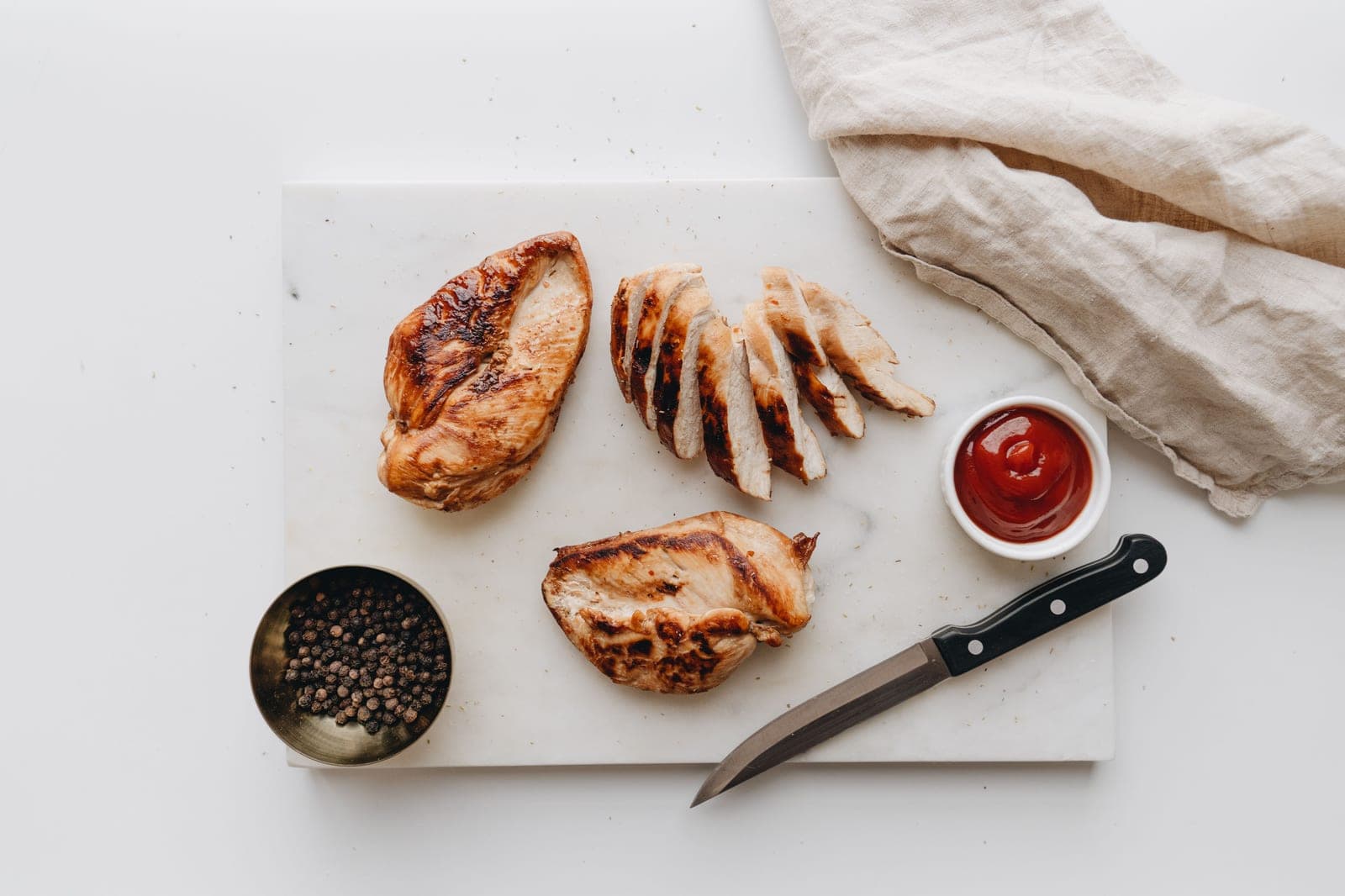
The rule in one line
The label on a package of chicken, and the "raw" entry in any database, describe the food before cooking. The "cooked" entry describes it after. Both are correct for their own weight. Weigh raw and log raw, or weigh cooked and log cooked, and the macros come out the same either way. Weigh cooked and log raw — which is what happens when someone portions Sunday's roasted chicken and taps the first entry in the app — and the protein is undercounted by roughly the weight the chicken lost in the oven.
Why the weights differ
Meat loses water. A chicken breast is mostly water, and roasting or grilling drives a good part of it off — the cooked piece is lighter than the raw one, commonly by something like a quarter, more if it is cooked hard, less if it is poached. The protein didn't leave; it is now a bigger share of a smaller weight, which is why 100 g of cooked chicken shows more protein than 100 g of raw in the same database.
Rice and grains gain water. Dry rice absorbs roughly two to three times its weight in water as it cooks, so a cup of dry rice becomes about three cups cooked. The carbohydrate didn't change; it is now a smaller share of a heavier weight, which is why 100 g of cooked rice shows far fewer carbs than 100 g of dry.
Fat added in the pan stays. Oil, butter and marinades are logged separately at the weight you added, regardless of raw or cooked. They are the one thing on the plate you should always weigh before it goes in.
The batch-cook shortcut
You don't need a yield table if you weigh the batch twice. Weigh the raw chicken (say 1,000 g, logged as raw against the package). Cook it. Weigh the whole cooked batch (say 740 g). Now every cooked gram is 1,000 ÷ 740 of a raw gram: divide the cooked batch into five 148 g portions and each one is 200 g raw. Log 200 g raw per container. The scale does the yield for you, for your chicken, at your oven's temperature, and it is exactly right for the batch in front of you instead of approximately right for an average one.
Rice works the same way in reverse: 300 g dry, cooked into 900 g, divided into five 180 g portions, each logged as 60 g dry. The only tool it needs is a scale that can tare a pot — 22 lb capacity for a rice cooker's inner pan with rice in it is why the Luminary is on this page.
A worked example
| Step | Chicken breast | Rice |
|---|---|---|
| Weigh raw / dry, log against the raw entry | 1,000 g raw | 300 g dry |
| Cook, then weigh the whole batch | 740 g cooked | 900 g cooked |
| Yield factor | 1,000 ÷ 740 = 1.35 raw g per cooked g | 300 ÷ 900 = 0.33 dry g per cooked g |
| Portion the cooked batch | 5 × 148 g | 5 × 180 g |
| Log per container | 200 g raw chicken | 60 g dry rice |
The figures are an illustration of the arithmetic, not a measured yield. Your batch's numbers come from your scale.
Where the yield numbers come from
If you want a published factor instead of your own, USDA FoodData Central has separate entries for the raw and cooked forms of most foods (for example, chicken breast raw versus roasted), and comparing the water content of the two entries is how a yield is derived. Every macro app's database, including the Nutritionix one behind the Etekcity and COSORI scales, ultimately draws on data like it. We link the database rather than print a table of factors, because the honest factor is the one you measure for your own batch; the shortcut above takes thirty seconds and is right every time.
The rest of the Sunday method — tare the container, weigh into it, five in a row — is on how to use a food scale for macros.
The scales this leads to
Our picks for this
A 1 g scale that tares a pot, with or without the app
 Stock photo
Best macro scale for the money
Etekcity ESN00 Smart Nutrition Scale
1 g · 11 lb · VeSync appApp sync7.9/101 g to 11 lb with the raw and cooked entries one tap apart in the VeSync app.
Check price · Amazon#ad · Price set by Amazon · Disclosure for the link to Etekcity ESN00 Smart Nutrition Scale
- Stock photo
Best smart scale for bulk prep
Etekcity Luminary Smart Nutrition Scale (ENS-L221S)
1 g · 22 lb · USB-CApp sync8.4/1022 lb capacity — tare the rice cooker's inner pan or a full sheet pan for the batch-weigh shortcut.
Check price · Amazon#ad · Price set by Amazon · Disclosure for the link to Etekcity Luminary Smart Nutrition Scale (ENS-L221S)
- Stock photo
Best plain scale
OXO Good Grips 11 lb Stainless Steel Food Scale with Pull-Out Display
1 g · 11 lb · pull-out display6.8/10No app; a pull-out display you can read under a big pan; log the raw gram figure yourself.
Check price · Amazon#ad · Price set by Amazon · Disclosure for the link to OXO Good Grips 11 lb Stainless Steel Food Scale with Pull-Out Display
How Meal & Macro scores gear
Units we claim to have tested: 0
Plenty of sites say they packed every container on the list for a week. We didn't, and we say so. What we do instead: read the lid, material and care ratings the maker actually publishes and repeat its wording ("leak-proof", "oven safe to 450°F", "top-rack only"), do the container-fit and ice-pack arithmetic from published dimensions and the USDA's numbers, and score every pick on a public rubric for its category that weights the seal, the material and the fit first. Every figure links to where it came from; where the maker's page would not load we cite a retailer and say so.
Scores are editorial judgments from that documented research, not test results. Commissions never set a score or decide a pick. The rubrics and their weights are published.
Questions
Frequently asked
Is it more accurate to weigh food raw or cooked?
Raw. The raw weight is the same regardless of how it's cooked; the cooked weight changes with time and temperature. Cooked is fine if you log the cooked entry.
How much weight does chicken lose when cooked?
Commonly around a quarter for a roasted or grilled breast, more when cooked hard, less when poached. Measure your own batch — weigh it raw and weigh it cooked — rather than trusting an average.
Do I weigh rice cooked or uncooked?
Dry is more repeatable: 60 g dry is always 60 g dry, while 180 g cooked depends on the water ratio. Either way, log the matching entry.
Does cooking change the calories?
Not the food's own calories — it changes the weight the calories are spread over. Added oil or butter is extra and is logged at the weight you added.
Keep reading
Related on Meal & Macro
Receipts
Sources
- USDA FoodData Central (nutrient database used for raw vs cooked yields) (checked 2026-09-21)
- Etekcity — ESN00 Smart Nutrition Scale page (capacity, graduation, units, platform, batteries, VeSync + Nutritionix, sync, warranty) (checked 2026-09-21)
- Etekcity — ENS-L221S-SUS Luminary Smart Nutrition Scale page (capacity, graduation, units, platform, USB-C battery, VeSync + Nutritionix, warranty) (checked 2026-09-21)
- OXO — 11 lb Stainless Steel Food Scale with Pull-Out Display page (1 g / 0.1 oz, dimensions, weight, 4 AAA; page blocked our reader, wording via the search index) (checked 2026-09-21)
We don't own or use-test this gear and we don't pretend to. Materials, capacities, seals and care ratings come from the maker's own product pages (linked on every product) or, where the maker's page would not load, from a retailer listing we label as such. Food-safety numbers are quoted from the USDA and FDA pages linked above. Where a figure isn't published we say so. Prices are set by Amazon and change often, so we don't print them. Read the full method.