Scales / Guide
How accurate are food scales? Resolution, minimum load and the five things that make one read wrong
Almost every kitchen scale sold for macro tracking reads in 1 gram steps. That number is the step size, not the error — and the specs that actually decide whether you can trust a reading are the minimum load and how you use the thing.
By Mike M.Updated Researched from maker spec pages
#adMeal & Macro earns from qualifying Amazon purchases. Prices are set by the retailer and change. A commission never decides a ranking. How we score · Disclosure
The short version
For weighing food, a $20 digital scale is more precise than the food is consistent. A 1 gram step on a 150 gram portion is 0.7%; the USDA entry you are logging that portion against is itself an average across samples of that food, and the breast you cooked is not the average. Chasing a more accurate scale is almost always the wrong optimization — but there are three cases where a scale genuinely misleads you, and they are worth knowing.
Resolution is not accuracy
Three different specs get collapsed into the word "accurate", and only one of them is printed on the box.
- Resolution (graduation). The smallest step the display will move in. Nearly every scale on this site publishes 1 g: Etekcity's ESN00 at "0.1 oz / 1 g / 1 mL", the Ozeri at "graduations of 0.1 oz (1 gram)", the Luminary at a "1g increment", COSORI in "1-gram increments". A scale with 1 g resolution displays 149 or 150, never 149.4.
- Accuracy (tolerance). How far the reading may sit from the true mass. Most kitchen-scale makers do not publish one at all. OXO is the exception on this site, stating readings "within 1/8 oz or 1 g" — in other words, roughly one graduation. Greater Goods describes "one gram accuracy" and says the scale "calibrates and shuts off automatically".
- Repeatability. Whether the same 150 g gives 150 g again five minutes later, on the same spot, at the same temperature. Nobody publishes this, and it is the one you can test yourself: weigh something, lift it, put it back, repeat.
The practical consequence: a scale advertising 0.1 g resolution is not necessarily more accurate than a 1 g scale. It just displays a smaller step — which on a cheap load cell often means displaying noise. For food, 1 g resolution with a stated tolerance beats 0.1 g resolution with no stated anything.
Minimum load: the spec nobody reads
Every digital scale has a weight below which it does not pretend to read. Most makers hide it; two on this site publish it, and the numbers are higher than people expect:
| Scale | Resolution, as published | Capacity | Minimum / tolerance stated |
|---|---|---|---|
| OXO 11 lb pull-out display | "0.1-oz (US) and 1-g (metric) increments" | 11 lb | "within 1/8 oz or 1 g" |
| Ozeri Touch (ZK21) | "graduations of 0.1 oz (1 gram)" | "up to 11 lbs 7.4 oz (5200 grams)" | Not published |
| Etekcity ESN00 | "0.1 oz / 1 g / 1 mL" | "11 lb / 5000 g" | Not published |
| Etekcity EK3551 (with bowl) | "Increments: 0.1oz/1g/1mL" | "weigh up to 11 lb" | "minimum weight recommendation: 5 g" |
| COSORI NutriLens | "1-gram increments" | "3 grams to 5,000 grams" | 3 g stated as the bottom of the range |
| Etekcity EK6015 | Graduation stated as "0.04oz (1g)" on the retailer listing; Etekcity's own page does not publish it | "11 lb / 5000 g" | Not published |
Each figure is the maker's published wording except where the row says otherwise. "Not published" means the page does not state it, so this page does not guess it.
A 3 to 5 gram floor is why a kitchen scale is the wrong tool for a 5 g scoop of creatine, a gram of salt or a 3 g dose of a supplement: you are at or below the bottom of the instrument's stated range, where the reading means very little. For food portions — 30 g of oats upwards — it never comes into play.
Five things that make a good scale read wrong
All five of these produce errors larger than any kitchen scale's own tolerance.
- An unlevel or soft surface. A load cell measures the force pressing straight down on it. On a tea towel, a cutting board that rocks, or a counter seam, part of the load is carried by the edge of the housing instead of the sensor. Bare, flat, level counter, every time.
- Off-centre loading. A single-sensor scale reads lowest in the corners. Four-sensor designs are better at this — Greater Goods publishes four sensors — but centring the bowl costs nothing and fixes it on any scale.
- Overhang. A plate wider than the platform is the most common real-world error, because it rests partly on the counter without you noticing. It is also the reason OXO's pull-out display exists: a big plate hides the numbers on every other scale here.
- Tare drift across a long session. Portioning five containers means five tares, and short auto-off timers compound it: the ESN00 and EK6015 both shut the display off after 120 seconds, while the Luminary's auto-off is adjustable to 300 seconds in the app. A scale that sleeps mid-portion and comes back zeroed on the full bowl is the classic way to log a meal at half its real weight.
- A dying battery. Low cells are the most common cause of a scale that reads consistently but wrongly. If a known weight suddenly reads 5% off, change the batteries before you blame the scale.
When 1 gram actually matters
Put the error in proportion to the thing being weighed. One gram of error is:
- 0.7% of a 150 g chicken breast portion — invisible against the natural variation between two breasts, and against the fact that the database entry is an average.
- 2% of a 50 g serving of oats — still far inside the noise of how level you scraped the cup.
- 7% of a 14 g tablespoon of peanut butter — now it is worth centring the jar properly, because fats are calorie-dense and this is where sloppy weighing shows up in a week's total.
- 20% of a 5 g creatine dose — out of scope for a kitchen scale, and at or below some makers' stated minimum anyway. Use the scoop that came with the tub.
So the honest answer to "is my scale accurate enough?" is: yes for food, no for supplements, and the bigger error in your tracking is almost certainly whether you weigh cooked or raw. That one is worth more than any upgrade: do you weigh food cooked or raw, and the method itself is on how to use a food scale for macros.
Scales that publish the numbers
Our picks for this
Four scales, chosen for what they state
Not the most features — the clearest published specs, plus the two design details that remove the biggest real-world errors.
Best plain scale
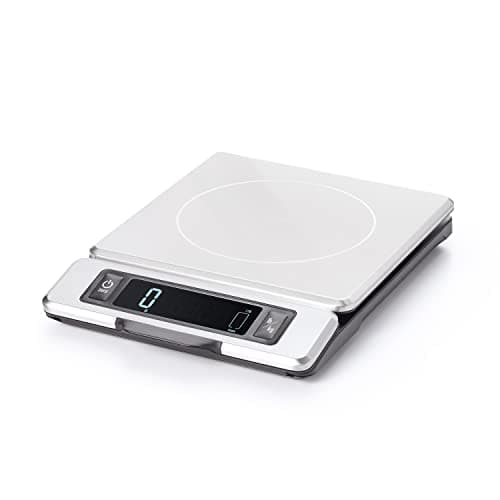
OXO Good Grips 11 lb Stainless Steel Food Scale with Pull-Out Display
1 g · 11 lb · pull-out display6.8/10The only pick here that publishes a tolerance — 'within 1/8 oz or 1 g' — and the pull-out display solves the overhang problem, which is the error that actually ruins readings. No app, no database.
$62.65Amazon#ad · Price as of November 4, 2026 · Disclosure for the link to OXO Good Grips 11 lb Stainless Steel Food Scale with Pull-Out Display
Best cheap scale overall
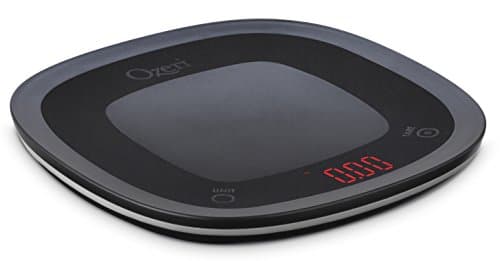
Ozeri Touch Waterproof Digital Kitchen Scale (ZK21)
1 g · 11 lb 7 oz · washable6.9/10Publishes its graduation (1 g) and its capacity (11 lb 7.4 oz), and it is 'waterproof, washable and submersible', so weighing raw meat does not end with a cloth over the sensor. Touch tare, four units.
$21.99Amazon#ad · Price as of November 4, 2026 · Disclosure for the link to Ozeri Touch Waterproof Digital Kitchen Scale (ZK21)
Best macro scale for the money
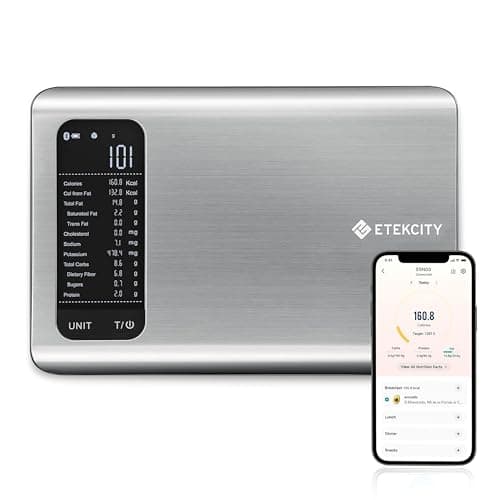
Etekcity ESN00 Smart Nutrition Scale
1 g · 11 lb · VeSync appApp sync7.9/101 g to 11 lb on a 9.2 by 6.3 inch platform that takes a dinner plate, plus the VeSync app and the Nutritionix database. Watch the 120-second auto-off when you are portioning five containers.
$39.99Amazon#ad · Price as of November 4, 2026 · Disclosure for the link to Etekcity ESN00 Smart Nutrition Scale
Best budget scale with a bowl
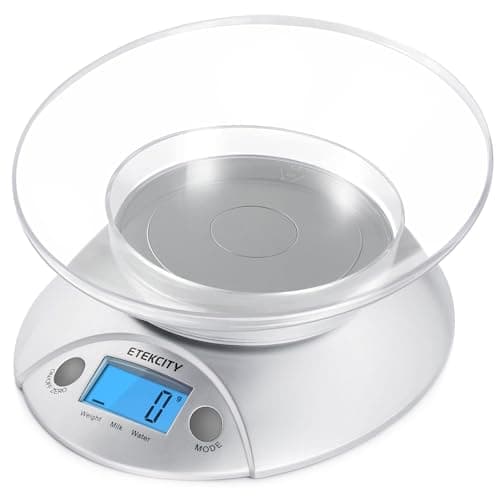
Etekcity EK3551 Kitchen Scale with Bowl
1 g · 11 lb · detachable steel bowl6.5/10The one that states a minimum: 'minimum weight recommendation: 5 g'. The detachable steel bowl removes off-centre loading entirely, and inverts into a cover so the scale still fits a drawer.
$16.99Amazon#ad · Price as of November 4, 2026 · Disclosure for the link to Etekcity EK3551 Kitchen Scale with Bowl
How Meal & Macro picks gear
Researched, compared and scored
Every pick starts with the maker's own product page and manual: the lid, material and care ratings in its exact wording ("leak-proof", "oven safe to 450°F", "top-rack only"), the container-fit and ice-pack arithmetic worked out from published dimensions and the USDA's numbers, and a score on a public rubric for the category that weights the seal, the material and the fit first. Models are compared side by side, so each page lands on one clear pick per use case with the reason stated. Every figure links to where it came from; where the maker's page would not load we cite a retailer and say so.
Scores are editorial judgments built from that documented research. Commissions never set a score or decide a pick. The rubrics and their weights are published.
Questions
Frequently asked
How accurate is a 1 gram food scale?
Accurate to roughly one graduation, which is what makers who publish a tolerance quote: OXO states readings "within 1/8 oz or 1 g". On a 150 g food portion that is under 1% — smaller than the variation between two pieces of the same food.
Do I need a 0.1 g scale for macro tracking?
No. A finer display is not the same as a more accurate reading, and food portions are weighed in tens and hundreds of grams. A 0.1 g jeweller's scale is for supplement doses, which several kitchen scales explicitly do not cover — COSORI states a 3 g minimum and the Etekcity EK3551 a 5 g one.
Why does my food scale give different readings?
In order of likelihood: the surface is not flat and hard, the load is off-centre or overhanging the platform, the display auto-slept mid-session and re-zeroed, or the batteries are low. All four produce bigger errors than the scale's own tolerance.
How do you test a food scale at home?
Weigh 500 ml of water, measured in a jug, into a tared container — it should read close to 500 g, since 1 ml of water weighs about 1 g. Do it three times to check repeatability. If one of those readings is wildly out, change the batteries and try again.
Keep reading
Related on Meal & Macro
- Is a food scale worth itWhether to own one at all, before worrying about precision.
- How to use a food scale for macrosThe tare-and-log method the readings feed.
- Do you weigh food cooked or rawThe error that dwarfs any scale's own.
- Best food scale for macrosThe ranked field, scored on published specs.
- Smart food scale vs regular food scaleBoth types read to the same graduation — so what are you buying?
Receipts
Sources
- OXO — 11 lb Stainless Steel Food Scale with Pull-Out Display page (1 g / 0.1 oz, dimensions, weight, 4 AAA; page blocked our reader, wording via the search index) (checked 2026-09-21)
- Amazon listing — Ozeri Touch waterproof digital kitchen scale, model ZK21-B (waterproof, washable and submersible, 11 lb 7.4 oz / 5,200 g capacity in 1 g graduations, g / lb:oz / fl:oz / ml units, touch tare, LED screen, 3 AAA batteries included; retailer listing, labeled) (checked 2026-10-04)
- Etekcity — ESN00 Smart Nutrition Scale page (capacity, graduation, units, platform, batteries, VeSync + Nutritionix, sync, warranty) (checked 2026-09-21)
- Amazon listing — Etekcity EK3551 food kitchen scale with bowl (11 lb capacity, 0.1 oz / 1 g / 1 mL increments, 5 g minimum recommended weight, oz / lb:oz / g / mL / fl oz units with water and milk volume modes, tare and auto-zero, detachable bowl that doubles as a cover, 8.66 × 6.89 × 2.17 in, 1.01 lb; retailer listing, labeled) (checked 2026-10-04)
- Etekcity — EK6015 Digital Kitchen Scale page (176 oz / 11 lb / 5000 g capacity, five units, 120-second display auto-off, 2 × AAA, dimensions, 2-year limited warranty, list price) (checked 2026-09-26)
- Walmart listing — Etekcity EK6015 Digital Food Scale (the graduation, stated as 0.04 oz / 1 g, and the 304 stainless platform; retailer listing, labeled, because Etekcity's own page does not publish the graduation) (checked 2026-09-26)
- COSORI — NutriLens Smart Kitchen Scale page (3 g–5,000 g in 1 g, 7 units, 1M+ food database, VeSync, 2-year warranty) (checked 2026-09-21)
- Greater Goods — Nutrition Food Scale (backlit) page (11 lb, 1 g, 2,000 ingredients, glass platform, AAA batteries) (checked 2026-09-21)
- Etekcity — ENS-L221S-SUS Luminary Smart Nutrition Scale page (capacity, graduation, units, platform, USB-C battery, VeSync + Nutritionix, warranty) (checked 2026-09-21)
- USDA FoodData Central (nutrient database used for raw vs cooked yields) (checked 2026-09-21)
Materials, capacities, seals and care ratings come from the maker's own product pages and manuals (linked on every product) or, where the maker's page would not load, from a retailer listing we label as such. Food-safety numbers are quoted from the USDA and FDA pages linked above. Where a figure isn't published we say so. Amazon sets the prices and changes them often, so the button on every pick checks today's. Read the full method.